Recovery after a non-ablative fractional laser follows a predictable 3–7 day course: redness and swelling on day one, a bronzed tint and sandpaper texture from day two as microscopic debris rises to the surface, then flaking until the skin is smooth again. Here is what each stage means, what to apply, and how it differs from an ablative CO2 laser. Your treating doctor's instructions always come first.
What a non-ablative fractional laser does to the skin
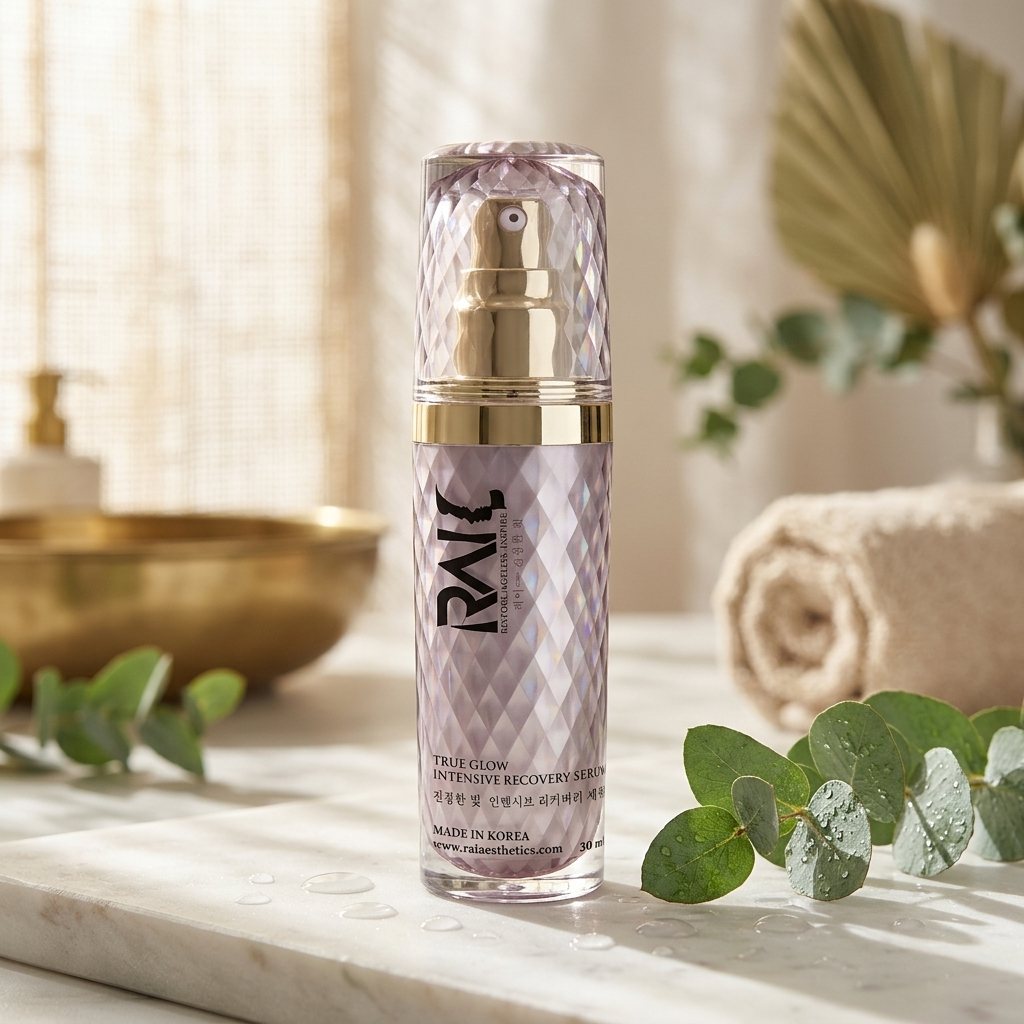
A non-ablative fractional laser (Fraxel-type 1550/1927 nm, thulium 1927 nm, LaseMD-type and similar devices) heats thousands of microscopic columns in the skin while leaving the surface between them intact, so the skin recovers from the untouched tissue around each column within days. Because the outer layer is never removed, there is no open wound, but the skin is still inflamed, dehydrated and shedding, which is why the first week is about hydration and protection. Once your doctor clears you to resume skincare, often from the first evening, a hydrating, fragrance-free recovery serum after laser is a common choice for the bronzing and flaking days.
Bronzing, sandpaper texture and MENDs: what is happening
The bronze tint and rough feel are the treated columns being pushed out of the skin as microscopic epidermal necrotic debris, known as MENDs, and they clear on their own within about a week. A histology study in Lasers in Surgery and Medicine saw MENDs as early as one day after treatment, found that they carry melanin, and observed them being shed from the epidermis within seven days, with the basal layer restored at 24 hours and the epidermis fully regenerated by day seven. Because the debris contains melanin, the skin looks tanned or dotted with tiny brown specks; this is not post-inflammatory hyperpigmentation and it lifts off with gentle cleansing. Do not scrub or pick it: the new skin beneath is still thin.
| Day | What you see and feel | What to do |
|---|---|---|
| Day 0 | Sunburn-like redness and heat; swelling, especially around the eyes | Cool packs through a cloth, head elevated, clinic products only |
| Days 1–2 | Redness fading to pink; swelling peaks then settles; bronzing starts; skin feels tight | Gentle cleanse, hydrating serum or bland moisturiser several times a day, SPF 50+ |
| Days 3–5 | Sandpaper texture, brown specks, flaking; itch is common | Keep hydrating; let flakes fall; no scrubs or actives; mineral makeup if skin is intact |
| Days 5–7 | Most flaking done; faint pinkness; skin smooth but sensitive | Continue sunscreen; discuss restarting actives with your doctor |
| Weeks 2–12 | Normal-looking skin; collagen remodelling continues | Daily sunscreen; next session commonly at about four weeks |
How long each side effect usually lasts
Redness is near universal and short, swelling peaks within two days, and bronzing can linger up to two weeks. A study in Dermatologic Surgery that surveyed patients at 60 follow-up visits after fractional photothermolysis (skin types I–IV) recorded transient redness in all of them, swelling in 82%, dry skin in 86.6%, flaking in 60% and bronzing in 26.6%, with acne-like breakouts in 10%; patients reported limiting social plans for an average of two days. DermNet's patient page gives similar ranges: minimal swelling settling within two to three days, a pink tone for about three to five days, and bronzing for three to fourteen days. If redness is still strong after two weeks, see our troubleshooting page on redness that will not go away after laser.

Aftercare: what to apply and what to avoid
Hydrate often, protect from the sun without exception, and add nothing that stings until the sandpaper phase has finished.
Apply
- Cool compresses through a clean cloth on day one, ten minutes at a time.
- A gentle, fragrance-free cleanser with fingertips and lukewarm water from the next morning.
- A hydrating serum or bland moisturiser two to four times a day for the first week.
- Broad-spectrum SPF 50+ every morning from day one or two as your doctor directs, plus a hat; DermNet advises continuing high-factor sunscreen for several months.
- Mineral makeup over intact skin from about day two or three, applied with clean brushes.
Avoid
- Retinoids, vitamin C, AHA/BHA, scrubs, cleansing brushes and alcohol toners until flaking has finished and your doctor clears them.
- Picking or rubbing off the bronze specks.
- Heat: hot showers on the face, saunas, steam rooms, hot yoga and heavy exercise for about 48–72 hours.
- Swimming pools and sea water until the surface is smooth.
- Unprotected sun for the first month; PIH risk is highest while the new skin is pink.
Dr Sin Yong recommends a hydrating recovery serum for his own patients from the day the skin has closed. If you are choosing a product yourself, our guide to how to choose a post-laser recovery serum lists what to look for and what to leave out.
PIH risk in Asian skin after fractional laser
Post-inflammatory hyperpigmentation is the complication Asian and darker-skinned patients most need to guard against, and it is linked to how much heat the skin receives. A retrospective study in Lasers in Surgery and Medicine of 37 Chinese patients treated over 119 sessions with a 1,540 nm fractional laser found generalised PIH in 7.1% of sessions at lower density and 12.4% at higher density, with localised PIH around the mouth mostly in those who did not receive air cooling; the authors concluded that energy, density and cooling all affect the risk. Three habits follow: tell your doctor about any history of melasma or PIH before treatment, keep the skin cool and hydrated in the first 72 hours, and use sunscreen daily for at least four weeks. New brown patches that appear after the bronze specks have shed, rather than with them, should be shown to your clinic; our guide to post-inflammatory hyperpigmentation explains the difference.
How this differs from a CO2 or ablative laser
The key difference is that an ablative laser removes the surface of each column, creating an open wound that weeps and crusts and takes one to two weeks to close, whereas a non-ablative fractional laser leaves the surface intact and recovers in about a week with no open skin. Ablative recovery means ointment-based wound care, higher infection and scarring risk, longer redness and stricter rules about water and makeup; non-ablative recovery means hydration, sunscreen and patience through the sandpaper days. Non-ablative lasers are usually done as a course of several sessions about a month apart. Our guides to skin recovery after CO2 laser and serums after ablative laser resurfacing cover the heavier end, and our explainer on ablative vs non-ablative laser recovery compares them side by side. If your treatment was a pigment-specific pico laser rather than a fractional device, the aftercare is shorter still; see recovery after pico laser.
When to contact your doctor
Most fractional laser recoveries are uneventful. Contact your clinic, with a photo, if you notice:
- Redness, swelling or pain that increases after day two instead of easing.
- Yellow or honey-coloured crusting, pus, an unpleasant smell, or redness spreading beyond the treated area.
- Clusters of small painful blisters, especially with a history of cold sores.
- Fever or chills.
- Blistering, weeping or raw patches, which are not expected after a non-ablative laser.
- Breakouts or small white bumps that do not settle within a week.
- New brown patches appearing after the bronze specks have shed, or redness still marked after two weeks.
Seek care urgently if there is spreading redness with fever, severe pain, or blistering across a wide area. Your treating doctor can judge whether a change is part of the normal course or needs attention, and will tell you what to stop and what to continue.
Frequently asked questions
How long does it take to recover from a fractional laser?
For a non-ablative fractional laser, redness and swelling settle within two to three days, bronzing and sandpaper texture peak around days three to five, and most flaking is done by day seven. Pinkness can linger up to two weeks. Ablative fractional lasers take longer. Follow your treating doctor's instructions for your specific settings.
Why does my skin look bronze and feel like sandpaper after Fraxel?
The treated microscopic columns are pushed out of the skin as melanin-containing debris, known as MENDs, which look like a tan or tiny brown specks and feel rough. A histology study saw them shed within about seven days. They are not pigmentation damage and should not be scrubbed off. Follow your treating doctor's instructions on cleansing.
What should I put on my face after a fractional laser?
Cool compresses on day one, then a gentle fragrance-free cleanser, a hydrating serum or bland moisturiser two to four times a day, and SPF 50+ every morning. A recovery serum after laser is formulated for this stage. Leave retinoids, acids and vitamin C off until flaking has finished, and follow your treating doctor's instructions on timing.
Can I wear makeup after a fractional laser?
Mineral or non-comedogenic makeup is usually fine over intact skin from about day two or three, applied with clean brushes and removed gently without rubbing. Avoid it over any raw, weeping or crusted area. Many people prefer to wait until the sandpaper phase has passed. Follow your treating doctor's instructions on when to start.
Is a fractional laser safe for Asian skin?
Non-ablative fractional lasers are widely used in Asian skin, but post-inflammatory hyperpigmentation is the main risk and rises with higher energy and density. A study of 37 Chinese patients found generalised PIH in roughly 7–12% depending on density. Conservative settings, cooling, hydration and strict sunscreen reduce the risk. Follow your treating doctor's instructions between sessions.
References
- Laubach HJ, Tannous Z, Anderson RR, Manstein D. Skin responses to fractional photothermolysis. Lasers in Surgery and Medicine. 2006;38(2):142-149. doi:10.1002/lsm.20254. PMID 16392146. https://doi.org/10.1002/lsm.20254
- Fisher GH, Geronemus RG. Short-term side effects of fractional photothermolysis. Dermatologic Surgery. 2005;31(9 Pt 2):1245-1249. PMID 16176779. https://pubmed.ncbi.nlm.nih.gov/16176779/
- Chan HH, Manstein D, Yu CS, Shek S, Kono T, Wei WI. The prevalence and risk factors of post-inflammatory hyperpigmentation after fractional resurfacing in Asians. Lasers in Surgery and Medicine. 2007;39(5):381-385. doi:10.1002/lsm.20512. PMID 17518354. https://doi.org/10.1002/lsm.20512
- Ngan V, Oakley A. Fractional laser treatment. DermNet NZ. 2007, updated 2015. https://dermnetnz.org/topics/fractional-laser-treatment